
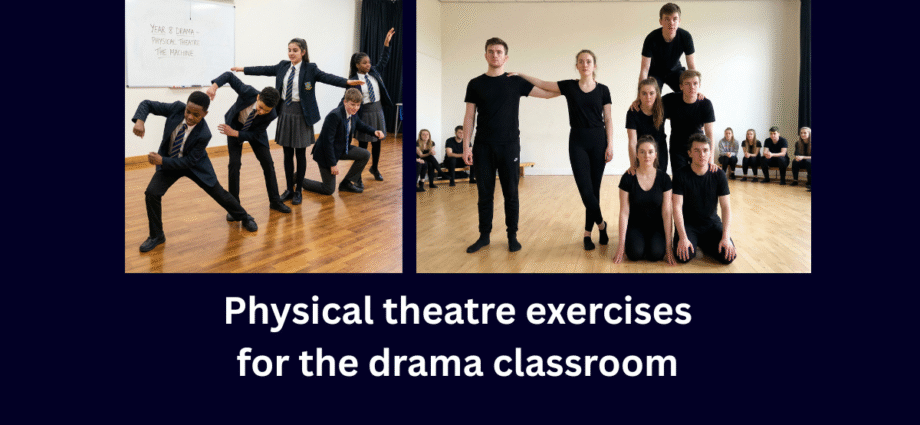
Physical theatre exercises are one of the most effective ways to get drama students working creatively, collaboratively and confidently. By focusing on movement rather than dialogue, physical theatre activities help students explore character, relationships and ideas in a highly visual and inclusive way.
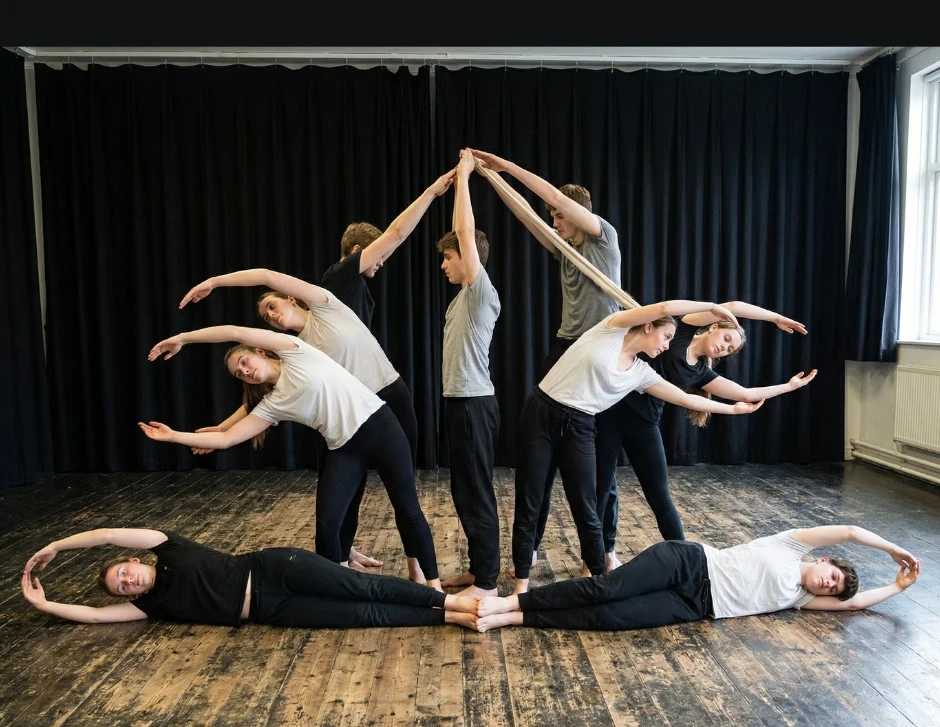
Whether you are teaching KS3 drama or developing GCSE and A Level devising work, physical theatre exercises offer practical, engaging approaches that suit a wide range of learners. They are particularly useful for ensemble building, abstract storytelling and encouraging students to move beyond naturalistic performance.
This guide brings together a selection of tried-and-tested physical theatre exercises commonly used in drama classrooms, along with a printable resource to support planning and delivery.
Why use physical theatre exercises?
Physical theatre exercises help students to:
- Develop ensemble skills and teamwork
- Communicate meaning without relying on speech
- Build confidence and physical awareness
- Explore character and emotion through movement
- Engage creatively with devising and scripted work
Because they rely less on text, these exercises are also highly inclusive and accessible for students with varying levels of confidence, literacy or language. They are particularly effective for supporting students with EAL (English as an Additional Language) to join in fully with drama activities.
Practical physical theatre exercises
Here are 12 physical theatre exercises you can use and adapt for your own classes. You will find a printable resource at the end of the article, and please remember to sign up for our newsletter at the bottom of the page to get future updates.
1. Round-By-Through
A core physical theatre exercise focusing on spatial awareness.
How it works:
Students move around an object, beside it, and then through it. The object may be a chair, table or another student. This works very well in groups of 3 or 4, giving each student a turn in the centre. Encourage changes in pace, level and intention and add in emotions to differentiate the movements. Build up into a short sequence by joining five or six passes together. Work on adding eye contact between students or the avoidance of eye contact, to give a different feel.
Focus:
Precision, spatial awareness, purposeful movement.
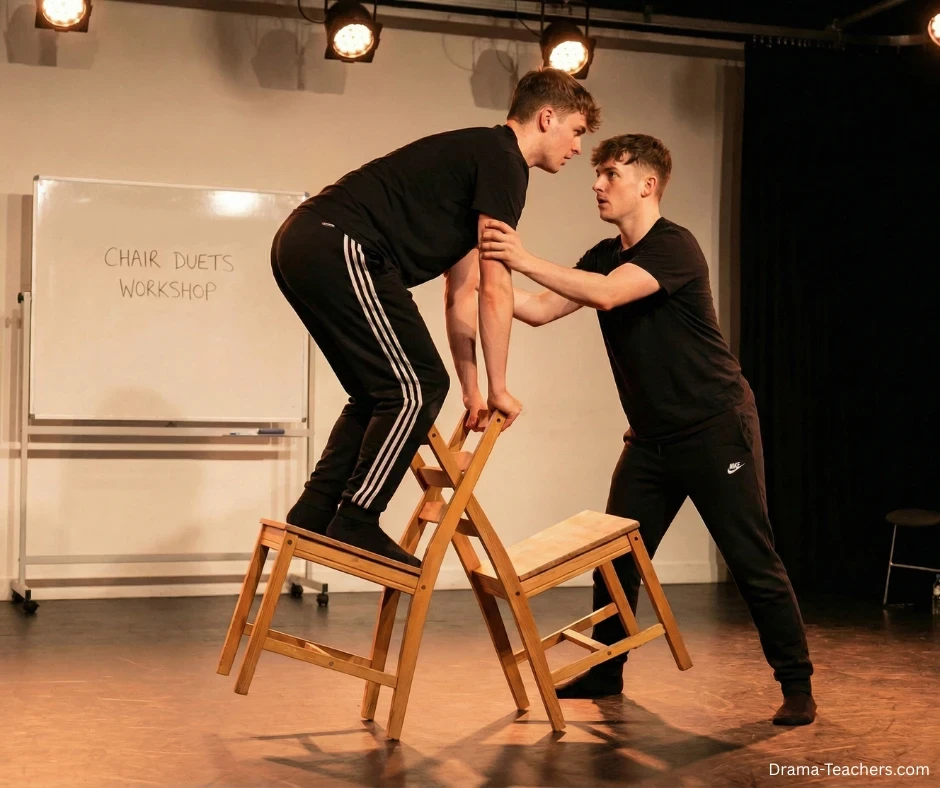
2. Chair duets
A classic physical theatre exercise exploring relationship and status.
How it works:
Two students create a sequence using simple gestures and two chairs. Each student has a chair. Start by using simple arm movements to connect to a partner (e.g. one puts their arm around the other); the other one moves or shifts position. Build up a short sequence of 10-12 simple movements that can be repeated. No talking is allowed.
Once students are confident with small movements, encourage them to use leg movements, turn away from and towards each other. They can move the chairs as well and encourage them to do things in canon (one after the other) and unison (both at the same time) to develop the piece.
Students may use music to help set the scene and explore ideas such as conflict, cooperation or power.
Focus:
Control, balance, non-verbal communication.
3. 10-second objects
A fast-paced ensemble exercise.
How it works:
With students working in small groups, call out an everyday object, such as a washing machine or playground slide. Students have 10 seconds to create the object physically before freezing. You can extend the time if needed.
You can extend this by moving on to scenes rather than objects (e.g. a beach scene, a scene at the opera or a busy market).
Focus:
Quick thinking, teamwork, clarity of physical storytelling.
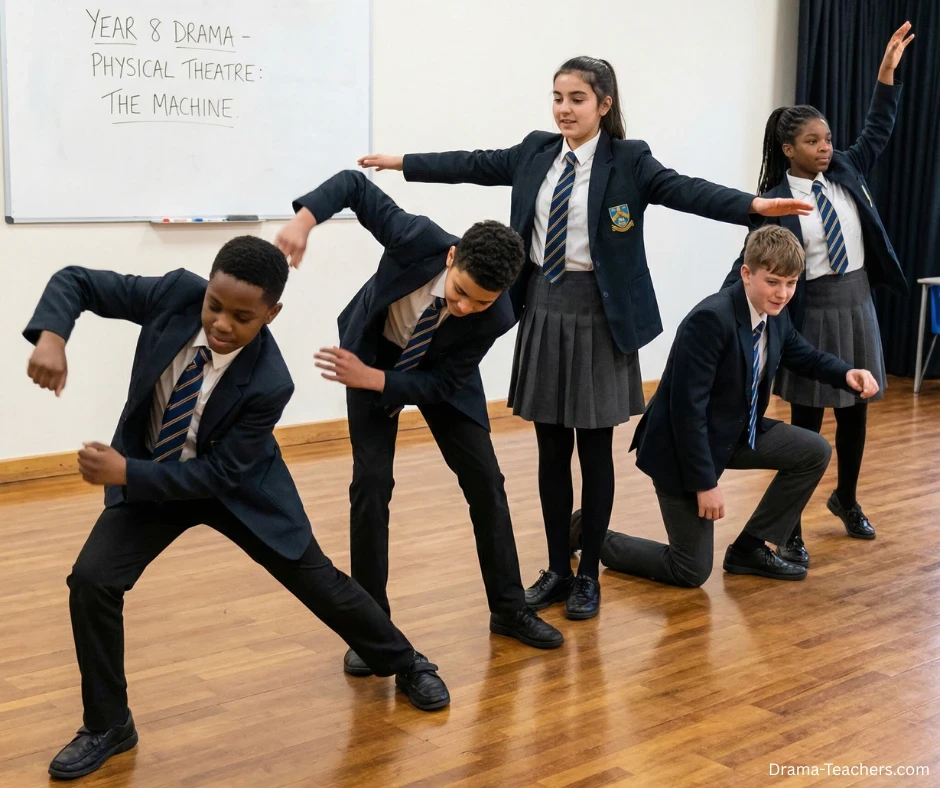
4. Human machines
An excellent ensemble-building task.
How it works:
One student begins a repeated movement. Others join one by one, connecting their movements and adding optional sounds. The idea is to create a ‘production line’ effect using their bodies. Encourage movement and sound effects created by voice and/or physical movements such as stamping and tapping.
Focus:
Rhythm, layering, ensemble awareness.
5. Mirroring
A concentration and control exercise.
How it works:
Students work in pairs, copying each other’s movements as accurately as possible. Progress from a clear leader and follower to shared leadership. Get other students to guess who is leading. This works best if the movements are slow and steady. Remind students that they are reflecting each other’s movements, as if looking in a mirror.
Focus:
Precision, trust, physical listening.
6. Follow the leader (movement focus)
A physical awareness and focus exercise.
How it works:
One student leads slow, deliberate movements while the rest of the group copies exactly. Change the leaders regularly, moving the last leader to the back of the line to join in again. Encourage students to explore different ways of moving, different levels and ideas such as rotation, hopping and jumping. Also ask them to play with speed, doing some movements fast and others slowly. Sound can be added as well.
Focus:
Observation, discipline and ensemble cohesion.
7. Emotional statues
A simple way to explore emotion physically.
How it works:
Call out an emotion. Students create a full-body still image to express it. Discuss which physical choices make the emotion readable by the audience. You can make this into a game by giving 2 or 3 students the emotion and asking others in their group to guess what the emotion is. Try to use more complex emotions rather than just ‘happy’ and ‘sad’.
Focus:
Emotional clarity, physical expression.
8. Physical storytelling (no words)
Encourages clear narrative through movement.
How it works:
Students retell a short story, myth or fairytale using only movement and gesture, with no spoken words. You can begin by asking them to recreate five or six freeze-frame images which tell the story. Once these have been established, you can bring them to life for 15 – 30 seconds each. An extension of this is to get the students to think about how they will transition from one freeze frame to the next efficiently.
Focus:
Narrative structure, transitions, ensemble timing.
9. Levels and pace work
Explores how movement choices communicate meaning.
How it works:
Students move using high, medium and low levels, changing pace on command. You can do this as an abstract movement piece or add emotions or intentions to deepen the task. You can set rules, for example, one person must always be lying on the floor, one kneeling, one standing and one on a chair. Try to get them to work without talking to develop trust and group dynamics. Change the pace at which they move frequently.
Focus:
Dynamics, control, intention.
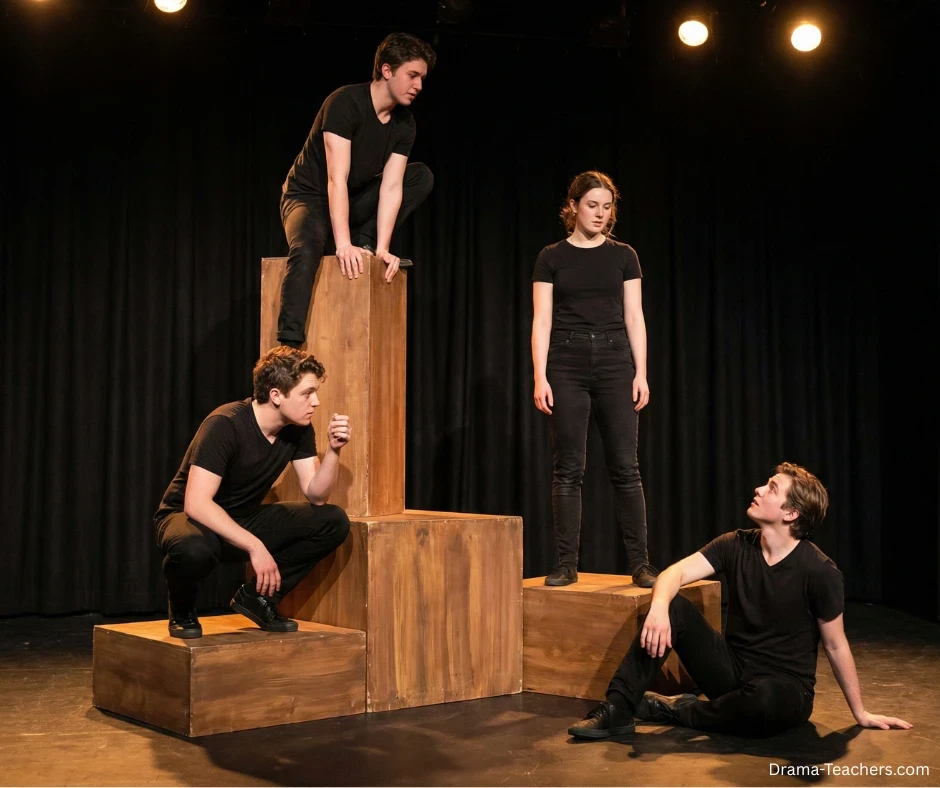
10. Group sculpting
A strong image-making exercise.
How it works:
One student sculpts others into a physical image without speaking. The sculptor then steps back to view and refine the overall picture. You can extend this by giving the sculptor a character (or letting them invent one of their own) to then explain their sculpture to an imaginary group of art critics. This can also be done in pairs.
Focus:
Composition, shape, visual clarity.
11. Slow motion sequences
Develops control and physical detail.
How it works:
Students perform a simple action or moment in extreme slow motion, focusing on control and precision. You can extend this by getting them to repeat the action, but this time going backwards, and at different speeds (half-speed, quarter-speed or even double-speed).
Focus:
Muscle control, awareness, detail.
12. Gesture amplification
Moves students away from naturalism.
How it works:
Students start with a small everyday gesture, such as a cough or a stumble or trip, and gradually exaggerate it, adding emotional intention until the movement is fully explored to its maximum. This works well in small groups where each student takes a turn at generating the action, with the following students each adding a level of exaggeration. The first student then moves to the end of the line, and the next student generates their own movement.
Focus:
Stylisation, expressive movement.
Teaching tip
Physical theatre works best when students understand there is no single correct answer. Encourage exploration, risk-taking and reflection rather than polished outcomes. Asking students to evaluate what communicates meaning most clearly helps develop analytical as well as practical skills.
Many of these exercises are strongly associated with the work of Frantic Assembly, whose education programme has had a significant influence on how physical theatre and ensemble work are taught in UK drama classrooms. Exercises such as Round-By-Through and Chair Duets are widely taught through their workshops and resources.
Printable resource: Physical theatre exercises
This post is supported by a printable Physical Theatre Exercises resource, ideal for lesson planning, cover work or student reference.
The printable includes:
- All 12 exercises in a clear, easy-to-use format
- Step-by-step instructions
- Focus points for each activity
- Suitable for KS3, GCSE and A Level drama
What a wonderful toolkit of exercises! The progression from trust-building games like ‘Leading the Blind’ to more advanced narrative work like ‘Gibberish Scenes’ provides a perfect pathway for developing an ensemble. These activities are not just for students—they’re brilliant warm-ups and creativity sparkers for any theatre company rehearsal. The ‘Stage Pictures/Tableaux’ exercise is a classic for a reason, and your prompts for exploring tension and emotion within it are very helpful!
Hi Cian. Thanks so much for taking the time to read the post and leave your thoughts. I’m so pleased that you liked the exercises and I agree, that these things are classic. I wanted to help everyone with some ideas for different exercises and I’ve used all of these successfully in classes myself, and also with youth theatres and adult amateur companies too. They work because they help you get past the ‘analytical brain’ and present something deeper that we can all connect with.
Physical theatre exercises help drama students communicate meaning through movement rather than words, developing strong ensemble skills, confidence, and physical awareness. They are highly inclusive, supporting students of all abilities and particularly those with EAL, while encouraging creative, non-naturalistic performance styles linked to practitioners such as Frantic Assembly.
Keep up the good work!
Hi S.J. Thanks for your kind comments and I’m pleased that you found the article useful for drama students and teachers. I will keep publishing more useful content so please come back soon. Gail
As a high school drama student, I found this so helpful! We often get stuck in our heads focusing only on the script, but these exercises—especially the ones on ensemble movement—remind us that our bodies are just as important as our voices. In your experience, do you have any tips for helping a group of teenagers get past the initial ‘awkwardness’ or self-consciousness that comes with physical theatre, especially when we’re asked to move in ways that feel a bit abstract?
Hi Leah. Welcome to Drama-Teachers.com. I’m so pleased you have found us and I hope you will visit often. I’m glad you found the post helpful. To answer your questions, I have a number of warm-up gamess and activities that I use which are usually done in teams such as the 10-second object exercise, or another one using levels where they are in groups and have to always have one standing, one sitting, one kneeling and one on the floor. You can add a chair if you have different numbers. I find that because there is a group feel and no one is in the ‘spotlight’ so to speak, that the students usually engage well. Add to that a bit of competition between groups by adding points to the best/fastest/most realistic etc., and I usually find that this overcomes any hestiation of nervousness. Then you can build up trust between yourself and the students and they are more open to more complex requests. Let me know how you get on. You might like to look at our post of warm-up activities too.