
We’ve all been there as drama teachers. You know that moment when you look around the drama room and realise the lesson has lost its rhythm? It might be straight after lunch, the last period on a Friday, or just after a scene that’s left everyone a bit quiet. Sometimes the group needs to move. Sometimes they need a minute to listen and settle. Here are five quick drama games you can use without props, with a simple way to bring each one to an end and get back into the lesson.
Why a flat class needs a different game from a warm-up
A warm-up prepares a class that arrives willing to work and is usually related to the content that follows. Students come in, the routine begins, and the warm-up or starter eases them into the work. A flat class is different; it’s already past that point. The students are present but switched off, so a gentle warm-up tends to match the low energy in the room instead of lifting it.
A rescue game has three jobs. It has to raise energy within a minute or two, so it needs a simple rule and quick turns. It has to include everyone, so nobody sits watching. And it has to end cleanly, because a game that cannot be stopped when you, the teacher, want it to, is a bigger problem than a flat class.
If you want a fuller set of routines for the start of a lesson, drama warm-up activities and why they’re important covers the reasoning behind them. The five games below are for the moment the lesson is already underway, or about to start, and the room is not with you.
1. Zip Zap Boing: sharpen attention and pace in a circle
Setup: The class stands in a circle and passes an invisible “energy” around using three words and three gestures.
How it works:
- Zip: clap and point to the person next to you. They receive it and pass it on the same way.
- Zap: clap and point to anyone across the circle. That person carries on from there.
- Boing: hold your hands up like a barrier. This sends the energy back to whoever passed it to you.
The rule that makes it work: Clap and give a clear cue, such as eye contact, pointing, turning towards someone or saying their name before you say the word. Without that, students mumble and the pass becomes unclear. With it, the game has a rhythm, and the rhythm is what pulls a distracted class back in.
Start slowly so everyone learns the three words, then ask for a faster pace. A mistake simply means the next person starts again. Nobody is out, so a slip costs a second and nobody sits down to watch.
To stop it: Call “last pass” and let the energy travel once more, ending on someone you choose. Their last word can be a quiet “zip” into a seated circle or a move into your next task.
Drama Teacher tip: There are a few different variations of this game; some use “Zip” to go clockwise, “Zap” to go anti-clockwise, and “Boing” to send the movement back in the opposite direction. Others have rules so that you have to go at least 3 turns in one direction to avoid get stuck with two players who keep the movement stuck in one area of the circle. It doesn’t really matter which one you go with as long as all the participants know the rules and what each action and sound means.
2. Yes, Let’s: get everyone moving and saying yes to ideas
Setup: One person calls out an activity beginning “Let’s…”, and the whole class answers “Yes, let’s!” and does it together.
The rule that makes it work: The group answers “Yes, let’s!” straight away, and everyone chooses how to join in. If someone calls, “Let’s all be penguins on a hot beach,” some pupils might waddle across the room, while others flap their flippers on the spot. Encourage everyone to participate in some way = a seated penguin still counts so long as there is evidence of the penguin.
Start by giving the first few suggestions yourself, so students see the level of silliness that is allowed. Then hand the calling to students one at a time. Their ideas will often be more varied than yours, and a class that is bored with you is often interested in the suggestions of their classmate.
To stop it: Make your own call the closing one: “Let’s all freeze like statues.” Follow with “Let’s all walk to our seats as if the floor were made of jelly.” The class is still in the game as they move into position.
Drama Teacher tip: This game is also useful for the quieter students. Calling out an idea takes less nerve than performing alone, because the whole room is doing it with you. If you want more games aimed at building that nerve over time, drama games to build confidence has a longer list.
3. Splat: quick reactions and names for a new group
Setup: One student stands in the middle of a circle. They point at someone and shout “Splat!”
How it works:
- The person who was pointed at ducks straight down.
- The two students on either side turn and point at each other.
- Whoever is slower swaps into the middle.
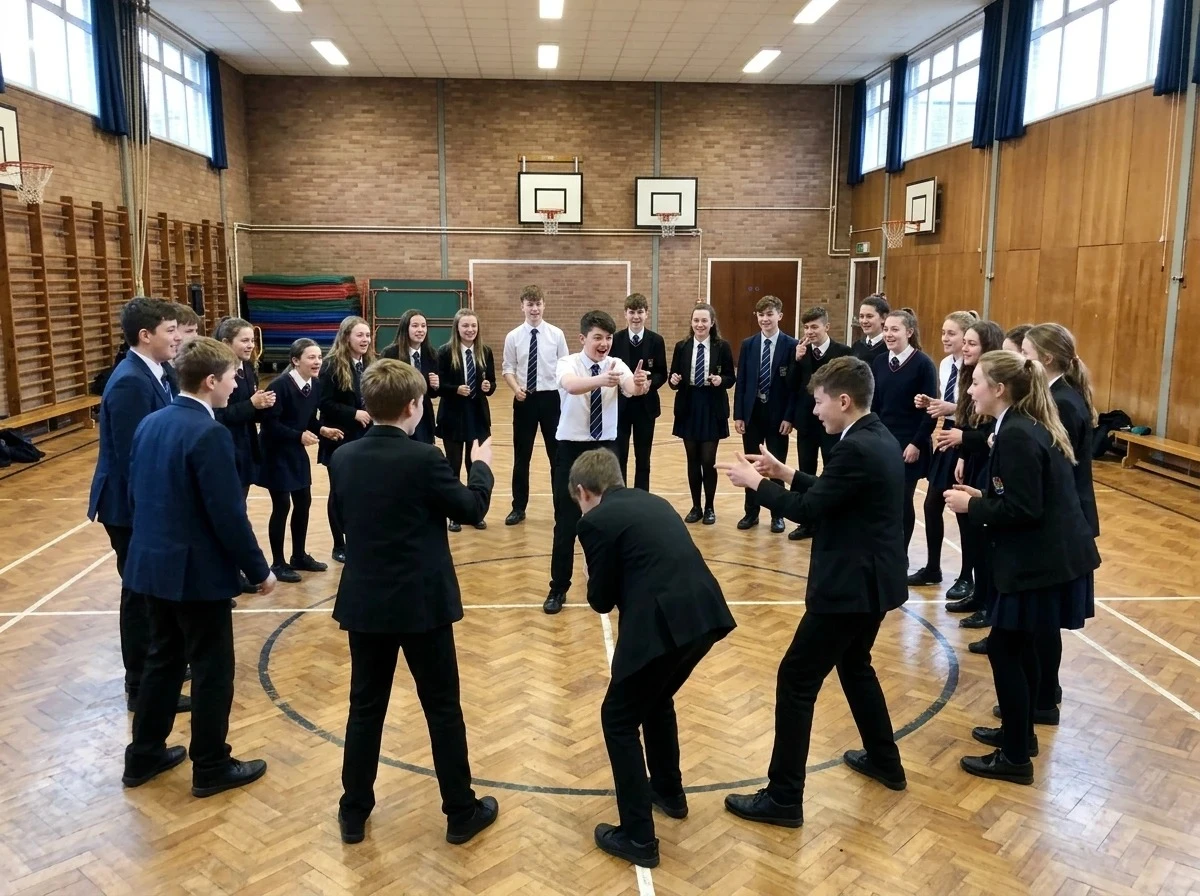
The rule that makes it work: Make this quick. It’s all about the reaction time and focus of the person being pointed at and the people either side of them. You can get the people either side to use each other’s names. If the group is new, go round the circle once before you start. If someone gets stuck, a classmate can quietly prompt them, and the game carries on. Change the person in the middle every few rounds so more pupils get a turn. The person in the middle should never stand there for more than a few seconds, because that is when energy drops. Nobody is eliminated, so the whole class stays involved.
To stop it: Call “three more splats,” count them down, and then ask the final person in the middle to choose where the class goes next, such as sitting down or forming groups.
Drama Teacher tip: You cannot expect your class to be energised if you are sitting on the side, directing from your swivel chair! Get involved at least for the first few goes and stand in the circle to model what you want them to achieve and the level of energy you expect.
4. Human Machines: build movement and teamwork in small groups
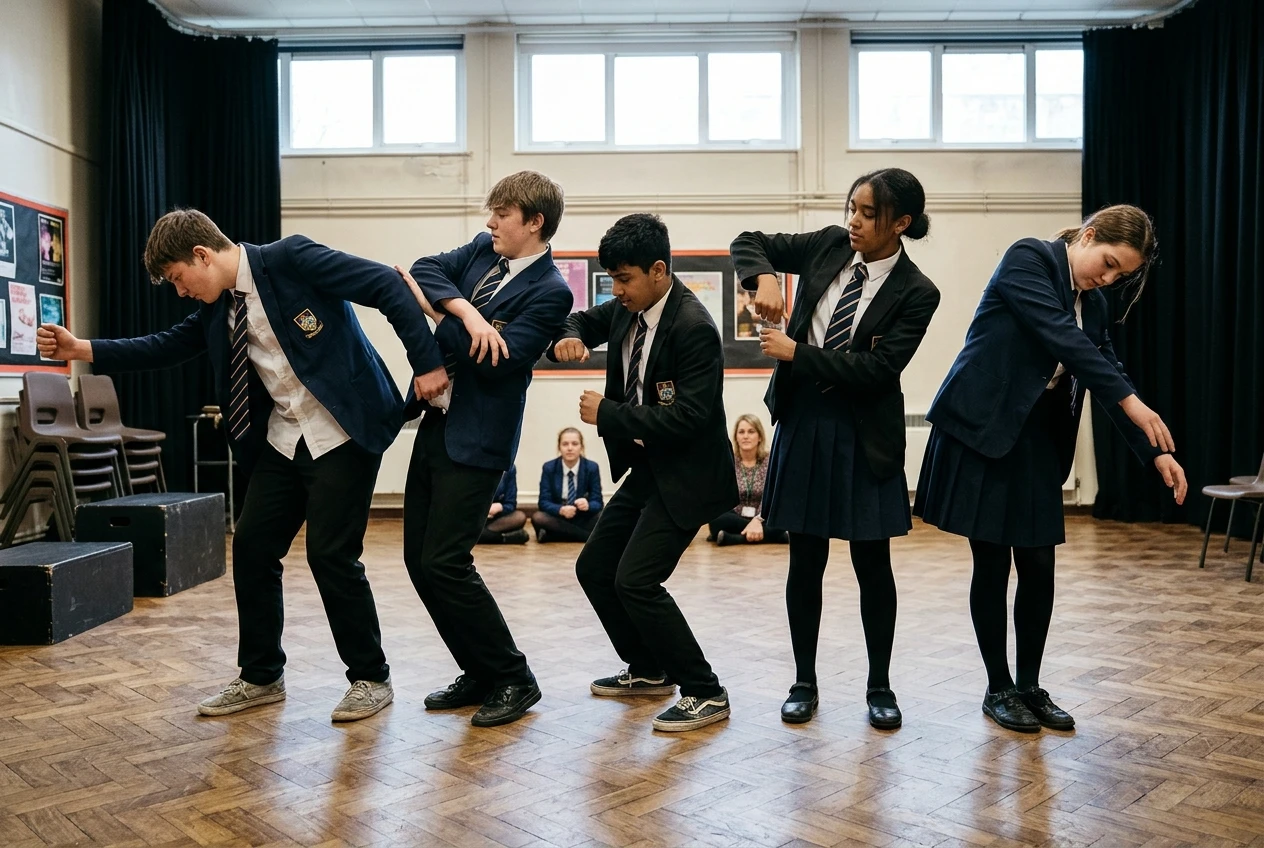
Setup: In groups of four to six, students build one working machine using their bodies using physical theatre techniques; each person acts as a connected part of the ‘machine’ with a repeating movement and sound.
The rule that makes it work: Every part must connect to another part. One student starts with a simple movement, such as a pumping arm, and repeats it. The next adds a movement that responds to the first. Within a minute, the group has a machine with no loose parts, and the connections force students to watch each other.
Give each group a purpose to build around: a bakery machine, a machine that sorts homework, a machine that makes weather. A theme gives the group something to agree on quickly, which keeps the planning part short and the moving part long.
Once the machines are running, you can change them without stopping the game. Ask for the machines to run at half speed, then double speed, then to break down. Each change is a new challenge and keeps the energy up for several minutes from a single setup. For more movement-based work that builds on this idea, see physical theatre exercises for the drama classroom.
To stop it: ask the machines to slow down gradually until they run in slow motion, then switch off one part at a time. The winding down lowers the volume without you having to raise yours.
Drama Teacher tip: Demonstrate some simple moves to get people started, such as pulling a lever, passing an imaginary box or turning in a circle before pointing. Ask them to think about different levels to generate other ideas too.
5. Count to Twenty: calm, focused energy once the room is buzzing
Setup: The class stands or sits in a circle, looks at the floor or closes their eyes, and tries to count from one to twenty aloud, one voice at a time.
The rule that makes it work: There is no order and no signalling. Anyone can say the next number, but if two people speak at the same time, the group goes back to one. Students cannot agree a pattern in advance, so they have to listen very closely to the room and try to sense when it is the best time for them to speak.
The game works because it needs quiet attention and focus. A class that arrives loud can be settled by it without a telling-off, as the silence between numbers becomes the point. Expect the first few attempts to fail around the number six or seven. That is normal and is part of why it works, since the group becomes more careful each time.
Do not make it a competition between classes or against a target. Let the group notice for themselves when they get further. If a student keeps interrupting on purpose, try the game again with eyes closed, which removes the audience.
To stop it: It ends by itself at twenty. Hold a short silence, then move to the next task in a calm voice.
Drama Teacher tip: In my experience, this can sometimes be dominated by a few people, so have the rule that each person can only count once. If they are struggling to get past the first few numbers, let them keep their eyes open and look around to get a ‘sense’ of who is going to speak until they get the hang of it.
How to end a game and move straight into your lesson
Stopping the game and moving onto the lesson is sometimes hard part, because energy you have raised does not vanish when you say “that’s enough.” Plan the exit before the game starts.
- Agree a stop signal at the start. A raised hand, a clap pattern or a countdown from five all work, as long as the class knows it before they are excited.
- Use a last round. “Last pass,” “final splat” or “final machine” gives the class a defined end and avoids the groans that come from a sudden halt.
- End with a movement that leads into the lesson. Finish seated, in groups, or in a line, depending on what comes next. The last action of the game should be the first action of the lesson.
- Lower your own voice. A quieter instruction makes the room come toward you. Raising your voice to compete with the energy tends to prolong it.
- Name the link. One sentence such as “We needed that listening for the scene work” connects the game to the lesson, so students see it as part of the lesson and not a break from it.
Keep the whole game to about five minutes. A game that runs past the point of interest loses the benefit it gave you.
Choosing the right game for the mood in the room
Look at how the class is functioning before you choose. Different kinds of flat classes call for different games.
- Sluggish and silent after lunch: Yes, Let’s. It gets bodies moving and voices out with very little risk
- Distracted and unfocused: Zip Zap Boing. The pace and clear clues demand attention
- A new group, or a group who barely know each other: Splat. It teaches names while it wakes people up
- Restless but willing to cooperate: Human Machines. It gives high energy a task and a result
- Overexcited, or settling after a heavy topic: Count to Twenty. It brings the volume down and builds shared attention
Heavy topics deserve a note. After difficult material, a loud, silly game can feel wrong. Count to Twenty or a slowed Human Machines suits that mood better, because it keeps the focus while easing the weight. If you are covering a lesson you did not plan, drama cover lessons: 10 easy ideas for non-specialist teachers has full lesson ideas to pair with these games.
Learn two or three of these well enough to run without thinking, and you will have a way to reset a class at any point in the day. Let me know what your favourite games are in the comments, too.
Enjoy!