
If you’re a drama teacher looking for creative ways to get your students thinking, collaborating and shaping their own performances, then this introduction to devising drama is a great place to begin. Devising drama means creating original work from scratch rather than using a set script. It gives students space to express themselves and also helps them develop teamwork, creativity and problem-solving skills. If you are teaching or preparing students for GCSE or A Levels (or other qualifications), then devising as a small group is usually part of the curriculum.
In this guide, I’m going to walk you through how to introduce devising in your classroom, along with some practical exercises and simple strategies that students genuinely enjoy.
What does devising drama mean?
Devising drama is when a group of performers creates a piece of theatre using their own ideas, interests and imaginations. Instead of starting with a script, students usually begin with a theme or a stimulus and build the characters, dialogue, movement and staging themselves.
The end result is completely unique to the group that creates it, which is why devised work often feels so personal and relevant to the students involved.
Many professional companies, including Complicité and Frantic Assembly, rely on devising as their main method of creating new work, and there have been many famous plays that started off being devised and were later written up as a script, such as:
Cloud Nine – Caryl Churchill (Joint Stock Theatre Group)
Developed using the Joint Stock method: the writer, actors and director ran workshops on sexual politics, sharing stories and improvisations. Churchill then went away and wrote the play, revising it again in rehearsal.
Things I Know To Be True – Andrew Bovell & Frantic Assembly
A collaboration where Bovell wrote the play in dialogue with Frantic Assembly’s physical-theatre devising methods and research and development workshops. It is now published as a script, but the movement language and some material came from the company’s devising process.
Too Much Punch for Judy – Mark Wheeller
A documentary/verbatim play built from interviews and real testimony about a drink-driving incident. The material was gathered and shaped into a script that has since become hugely popular in schools and colleges.
These examples help students understand that devised work can lead to powerful, polished theatre.
Devising gives my students the chance to experiment, take risks and find their own voice in a supportive environment. I love to encourage them to think outside the box and come up with creative ideas to tell stories, so we often have stories told through a game show or a Jerry Springer-inspired scene.
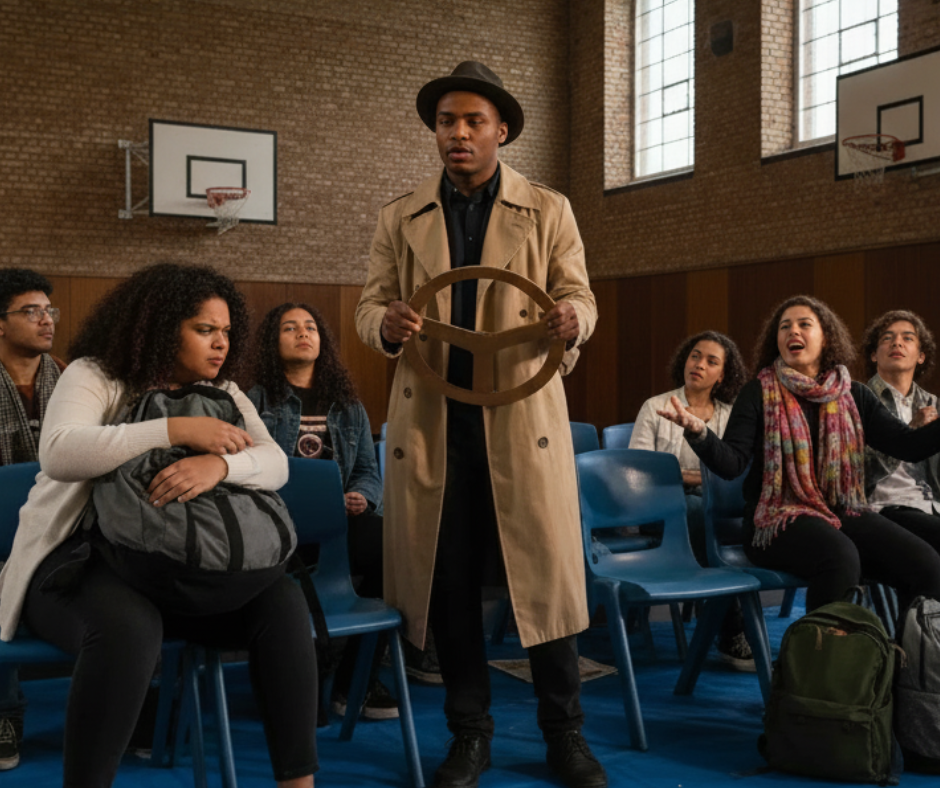 Simple props or costumes can help students get into character.
Why devising matters
Devising is so much more than just “making up a play.” It encourages students to think creatively, listen to each other, negotiate ideas and make creative decisions together. It’s one of the best ways to help build confidence because students see their own ideas take shape in front of them. However, if you have particularly dominant students, then you may need to help establish some ground rules about including everyone’s ideas, rather than letting one assertive person run the show.
When these checks and balances are in place, devising becomes naturally inclusive. Even students who worry about learning lines or playing large roles often find a place in devising, whether that’s in a movement piece, helping to design the set, lighting or costumes, or playing small supporting roles in the group. There’s genuinely room for everyone.
A simple structure for introducing devising
I’ve found that students work best when the process is broken into clear, manageable steps. Here’s the structure that works well when starting out. You could use this to introduce students to a ‘template’ for how to proceed from idea to performance.
1. Choose a stimulus
This could be an image, object, piece of music, headline, poem or anything that sparks curiosity.
Quick activity: Bring in a box of random objects and ask groups to create a one-minute scene inspired by the object they are given.
2. Generate ideas
Brainstorm questions, themes and characters based on the stimulus. This could include mind maps, free writing, verbatim ideas or the results of a simple discussion – all work well.
3. Explore through improvisation and experimentation
Encourage groups to try out ideas without worrying about perfection. Improvisation and experimentation are where the unexpected, exciting material often appears. I like to encourage students to explore different genres, such as melodrama, TV documentary, game shows, opera, pantomime and a whole host of other genres that they could use to tell the story, rather than the more traditional, linear narrative route.
Encourage them to try several ideas to see what works best.
I’ve created a free downloadable genre list you can use in your lessons or give out to students to help them approach storytelling in fresh and playful ways. You can download it here. Students love having this as a reference sheet.
You can also encourage them to play with different drama techniques such as Thought-in-the-Head, Conscience Alley, Flashforward/Flashback and Slow/Fast Motion.
4. Structure the material
Help students organise the strongest moments into a rough sequence. Ask them to consider the order of scenes and how the story unfolds.
5. Rehearse and refine
Run the scenes several times, shaping and improving as they go. Peer feedback is especially helpful here.
6. Perform and reflect
Share the work with the class or a wider audience. Afterwards, reflect on what went well and what could be improved next time.
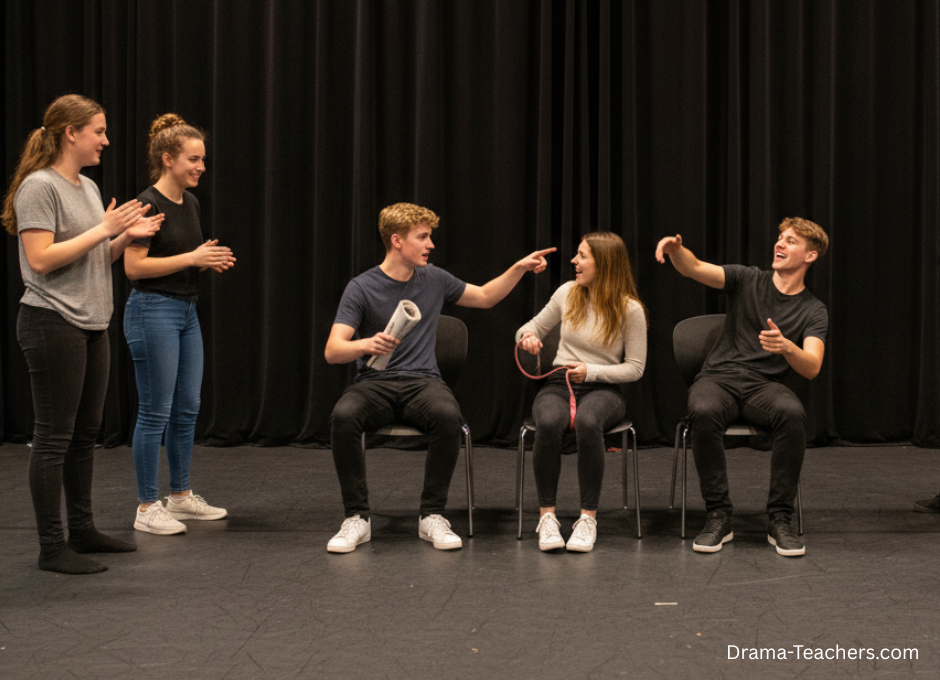
Helpful devising exercises
These activities are simple, reliable, and always help students generate material when they start devising.
- Freeze Frame/Still Image (tableaux): Great for exploring themes and building strong stage pictures – get the students to then bring the image to life for 30 seconds and see what develops. You can do an advanced version by asking them to go back 30 seconds to see how they all ended up in that particular pose. You can also ask them to jump forward thirty seconds to see what happens next
- Thought tracking/Thought-in-the-head: Tap a student in a still image to speak their inner thoughts. You can then go around the group and use these thoughts as the start of a monologue
- Physical storytelling: Tell a story using only movement. Try using stylised movements or mimes and explore what happens when you do the moves as a chorus
- Hot-seating: Interview a character to deepen backstory and motivation, then use this to create monologues or flashbacks
- Soundscapes: Use voices and objects to build a sound environment that inspires scene ideas
Students soon realise there are no “wrong answers” in devising, only different possibilities that they can explore, develop and choose to use or not.
Common challenges and suggested solutions
When working in groups, you will inevitably come across a range of challenges. Hopefully, the students will learn to work through these to resolve the issues, but may occasionally need some help from you, the teacher.
- Group disagreements: Encourage open discussion. If the discussion stalls, ask the group to try both ideas quickly and compare
- Lack of ideas: Return to the original stimulus or try a short improvisation game to spark fresh thinking
- Loss of focus: Give groups simple checklists or mini-goals to complete each session
- No shows at rehearsals: This is something we all deal with and when students are left to organise and rehearse independently, this can be a problem if one or two people are consistently missing. Organise a group meeting to discuss the issues, or speak individually to people if their attendance is not what the group needs
With patience and gentle guidance, most groups find their rhythm quickly.
Taking devising further
Once students feel confident, try introducing:
Nonnaturalistic techniques: Symbolic movement, stylised voice or abstract staging can help students think beyond realism.
Split scenes: Show multiple places or times at once for creative storytelling.
Verbatim theatre: Use real words from interviews or research to explore authentic stories.
These approaches often lead to powerful and memorable performances.
Planning and assessment ideas
If you are preparing students for an assessment such as a GCSE/A Level or internal assessment, try to balance practical workshops with opportunities for reflection. Encourage students to write simple devising journals as they go along, take rehearsal photos and video diaries and give them self-assessment tasks to help them trace their own progress throughout the process. Photos and short video clips also give students evidence for reflection and act as an aide memoire of rehearsals.
You could also try:
- Asking students to write about their favourite rehearsal moment
- Using peer feedback during run-throughs
- Setting clear success criteria for teamwork and contribution
Assessment should cover both the devising process as well as the final piece. In fact, the process here is more informative and often more valuable to help your students progress. They learn to set goals, experiment and see what works and what doesn’t.
Teacher feedback should be specific, practical and direct so students can celebrate wins and figure out what to improve next time.
Bringing it all together
Devising drama gives students ownership, confidence and a real sense of creative freedom, and it is a core part of the GCSE and A Level curriculum. With a clear structure, a few well-chosen exercises and a supportive atmosphere, you’ll be amazed at what they produce and how much they grow through the process. It’s one of the most rewarding parts of drama teaching, and once students experience it, they often ask for more.
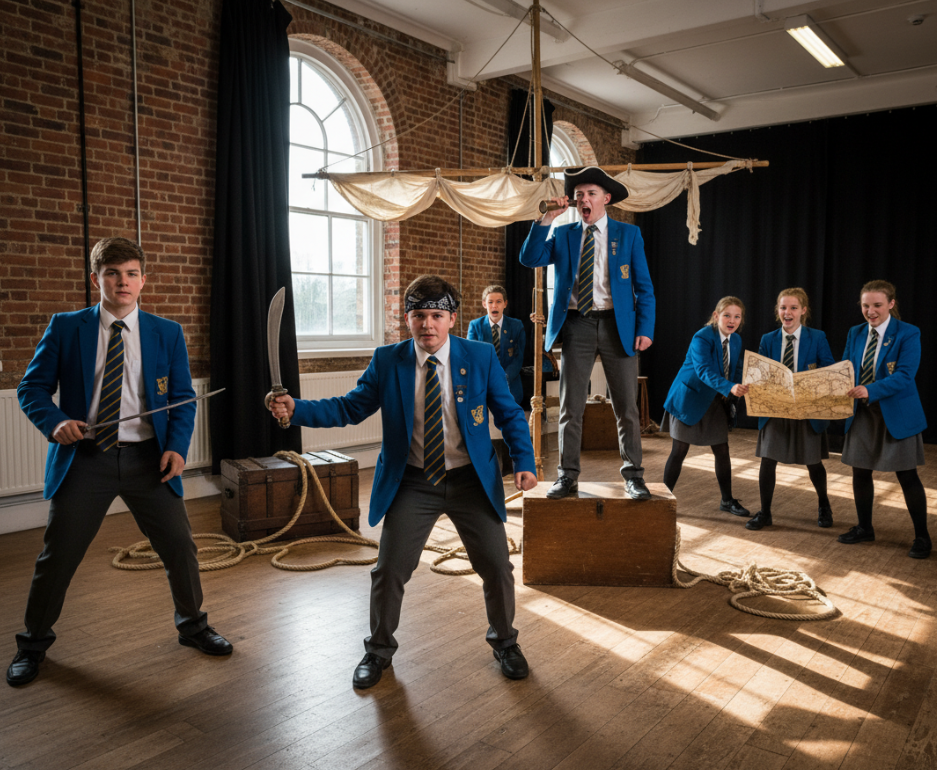 Use props and costumes to help with improvisation and devising.
Frequently asked questions about devising drama
What if students are nervous about improvising?
Start with small-group and low-pressure activities. Lots of encouragement and celebrating everyone’s efforts go a long way.
How do I make sure everyone is included when devising?
Assign roles to each group or prefer,bly, have them decide for themselves. Roles include director, recorder, performer, and designers (lighting, sound, costume), so everyone can try different things and feel like they’re part of the group’s work.
How can I help a group that just can’t agree?
I remind them that there isn’t always one correct answer. Sometimes it helps to test out several ideas or combine the best of each to find a solution everyone supports.
Bringing it all together
Devising drama opens up loads of creative opportunities for students. By starting with a clear structure, mixing in practical exercises, and supporting students through challenges, I see them grow not only as performers but as team members and problem-solvers. If you give this approach a chance, you’ll probably be amazed at what your students produce and how much they enjoy the adventure of making theatre together.
Useful Resources
This article contains some affiliate links, which means that if you decide to buy, I may receive a small commission at no extra cost to you. As an Amazon Associate, I earn from qualifying purchases. This helps me keep The Creative Choice growing and free for readers. I appreciate your support. For more information, see our Affiliate Disclosure.
Here are some books from Amazon that I have found particularly useful on the subject of devised drama.
- The Frantic Assembly Book of Devising Theatre – a great resource for devising, and you can see their techniques easily in their productions. Frantic Assembly offer a lot of workshops for schools, which have always been well received by the students, and give them lots of ideas.
- 200 Themes for Devising Theatre with 11–18 Year Olds: A Drama Teacher’s Resource Book – a useful little book to help Drama Teachers find ideas for stimuli and age-appropriate topics for devising
- Drama Games for Devising – another useful little book with lots of games and ideas to use in lesson working on devising
Some of the links above contain affiliate links, which means that if you decide to buy, I may receive a small commission at no extra cost to you. As an Amazon Associate, I earn from qualifying purchases. This helps me keep The Creative Choice growing and free for readers. I appreciate your support. For more information, see our Affiliate Disclosure.
Related Posts
Best Acting Techniques for Beginners
Teacher’s Guide to A Midsummer Night’s Dream
This was a surprisingly enjoyable read. I’m not a drama teacher, but I love seeing how creativity gets unlocked in a classroom setting, and devising drama seems like one of those rare approaches that really helps students come out of their shell. The step-by-step structure you laid out makes the whole process feel doable, even for kids who might be shy or unsure of themselves.
What really stood out to me is how inclusive this method can be, not every student wants a big speaking role, but giving them space to contribute through movement, directing, props, or design lets everyone find their place. That kind of teamwork builds confidence in a way a traditional script sometimes can’t.
The practical exercises and troubleshooting tips were super helpful too. I can see how things like freeze frames, hot-seating, and soundscapes would spark ideas fast. It’s a reminder that creativity doesn’t always show up on command — sometimes you just need the right prompt to bring it out.
Great guide! Even as someone outside the drama world, it’s easy to appreciate how much this kind of hands-on learning helps students grow.
Hi Jason. Good to meet you here and I’m so pleased you found the post interesting and can see its value, even if you are not a drama teacher yourself. You’re correct that many students may not find drama their niche subject – many do and are passionate about it, but there are others for whom it is a challenge. (Like me and cooking! LOL). You’re also correct in saying that we can find an inclusive and compassionate approach, and everyone can find their level so they are learning something, even if that is teamwork.
I appreciate your time to read and leave a comment. Come back soon! Gail
Devising drama lets students create original performances from scratch, boosting creativity, teamwork, and problem-solving. Starting with a stimulus, they generate ideas, experiment through improvisation, structure scenes, and refine them through rehearsal. Exercises like freeze frames, thought tracking, and soundscapes help inspire material, while strategies like role assignments and reflection ensure everyone contributes. This approach builds confidence, encourages risk-taking, and gives students ownership of their work, making it an engaging and valuable part of drama education.
Keep up the good work!
Dear S.J. Thanks for your kind comments on this article. You have understood the devising process well. Is there a technique you prefer to use? Gail
This is such a clear and inspiring introduction to devising! As a drama teacher, I’m always looking for effective ways to guide students from initial ideas to polished performance, and this breakdown of techniques, from image theatre to collective creation, is incredibly practical. I especially appreciate the emphasis on creating a safe, collaborative space where every student’s voice can be heard. This will be a fantastic resource for my curriculum. Thank you for sharing these valuable strategies!
Hi Cian. Thanks for your kind comments and I’m so pleased that you found it useful. I love creating devised pieces and seeing what the students can come up with but they sometimes struggle with starting with a blank page. I hope you use the genres download to help give them a few starter ideas, from which they can then launch a masterpiece! All the best, Gail.