
Physical theatre is a practical, creative approach to performance that puts the body at the centre of storytelling. Instead of relying mainly on spoken words, physical theatre uses movement, gesture and visual imagery to communicate meaning. By focusing on physical expression, performers can explore atmosphere, character and narrative in ways that support and stretch more traditional drama techniques.
For drama teachers, physical theatre offers students fresh ways to approach texts and storytelling, build confidence and work as a team. It creates new possibilities for devised work and can support the interpretation of scripts and improvisation exercises, making lessons more varied and memorable for students of all ages.
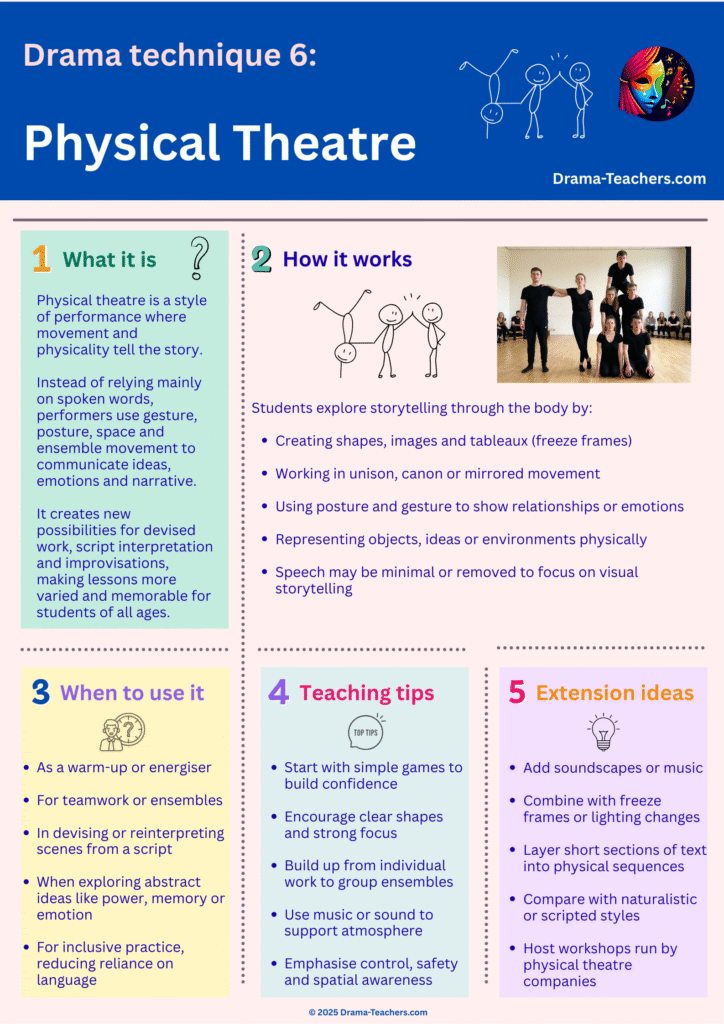
What is Physical Theatre?
Physical theatre is a style of performance where movement and physicality are the main methods of expression. While it can include elements of mime, dance or even circus, the key principle is that the body tells the story and creates the scene. Performers might create abstract shapes, use their bodies to represent objects or ideas, or work together to create strong ensemble images.
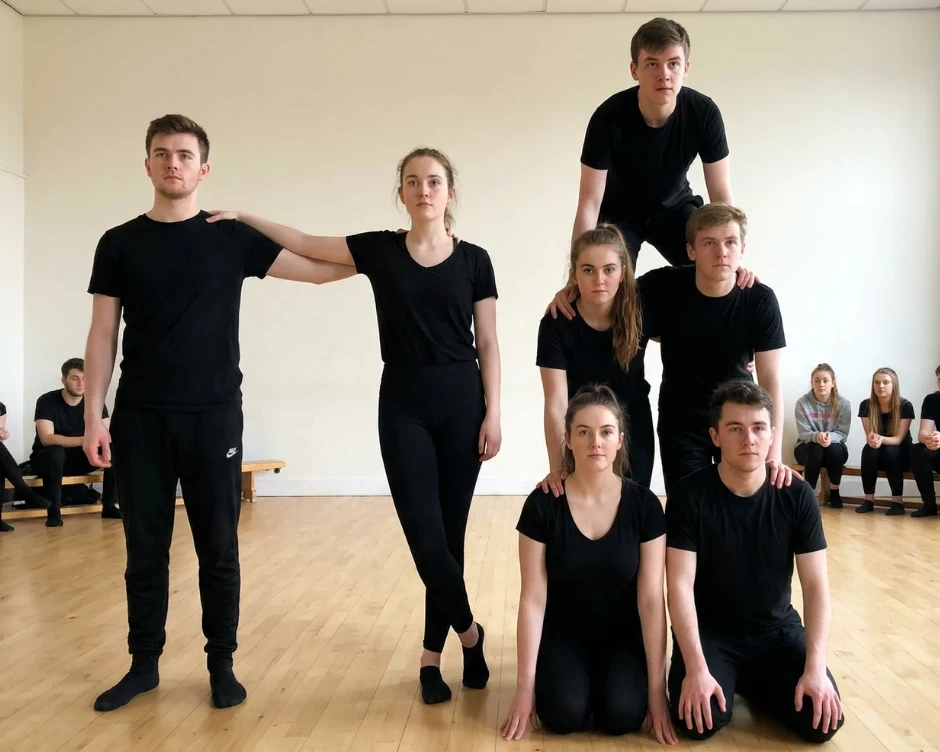
Using physicality to create a doorway and a tower.
Spoken text may be used sparingly or not at all, allowing meaning, mood and narrative to grow through action, spatial design and physical relationships.
Companies such as Frantic Assembly and Complicité have helped bring physical theatre to wider audiences in the UK and internationally. The style also draws on the work of practitioners such as Jacques Lecoq, whose teaching focused on the expressive potential of the human body on stage.
Over time, physical theatre has become a popular and accessible approach within school drama, youth theatre and professional performance, particularly because of its emphasis on ensemble work and visual storytelling.
How it works
Physical theatre usually begins with practical exploration. Students take part in warm-ups and games that build awareness of their bodies, the space around them and the people they are working with.
Early activities might include mirroring, moving at different levels, or responding physically to music or sounds. These exercises encourage focus, coordination and confidence without the pressure of spoken performance.
As students develop, tasks become more structured and collaborative. Group movement, working in unison or canon, and building tableaux (freeze frames) help students develop ensemble skills. Teachers may ask students to:
- Create physical images that represent a theme, character or moment
- Use posture and gesture to show relationships or emotions
- Transform a story or stimulus into a sequence of movements
- Adapt a scripted scene by adding non-verbal moments
Physical theatre can be used individually, in pairs or in small groups. It works well as a warm-up, a tool for character exploration, or as the foundation for devised performances.
When to use it
Physical theatre can be introduced at any key stage and adapted for different ages and experience levels.
It can be particularly effective:
- To reinterpret texts – students can show key moments using movement alone
- To build ensemble skills – activities encourage trust, focus and teamwork
- For devising work – groups can create original pieces from themes, poems or images
- To explore abstract ideas – such as time, memory, power or emotion
- As an energiser – physical work keeps engagement high during longer lessons or rehearsals
- For inclusivity – physical theatre reduces reliance on language and supports a wide range of learners
Teaching tips
- Start with games – playful activities help reduce self-consciousness and build confidence
- Set clear expectations – explain the purpose of each task and model examples where possible
- Build gradually – move from simple shapes and actions to more complex group work
- Encourage reflection – ask students to discuss what worked and how meaning was communicated
- Focus on safety – warm up properly and remind students about spatial awareness and control
- Celebrate effort, not perfection – physical theatre is about exploration and expression
Extension ideas
Here are some ideas to use to extend the work or stretch and challenge participants:
- Combine physical theatre with soundscapes or music to develop atmosphere
- Use lighting levels or freeze frames to highlight key moments
- Ask students to layer physical theatre with short sections of text
- Compare physical theatre approaches with naturalism or scripted realism
- Use physical theatre to stage transitions between scenes
- Host workshops run by external physical theatre companies such as Frantic Assembly and Complicité, who often have extensive education programmes
Free download: Physical Theatre technique sheet
Want to keep a copy for your planning or classroom wall?
Download our FREE printable: Drama Techniques 6: Physical Theatre
Includes an overview, how-to steps, teaching tips and extension ideas – all in one colourful A4 resource.
Other techniques to explore
Drama Techniques 5: Conscience Alley
Drama Techniques 7: Marking the Moment
Thank you for putting together such a comprehensive and well-structured guide to Physical Theatre! As a drama teacher, having clear definitions of techniques like Corporeal Mime and Viewpoints, along with practical exercise ideas, is an invaluable resource for lesson planning. It’s great to have a trusted reference to point my students toward for understanding the ‘why’ behind the movement!
Hi again Cian. I’m so pleased that you think this will be useful for students too. I think it can help them with devising and with rehearsal techniques for A Level Drama. I have used this with students for a long time and they really get into the work when they start thinking outside the box. Using stylised movement with music is a great way to present ideas and commentary and we have used it for many different topics. It somehow just connects to the audience that language sometimes misses. Thanks for your insights here and all the best with your own productions and classes.
This is such an insightful overview of physical theatre! I love how it highlights the power of the body in storytelling and the ways students can explore character, emotion, and ensemble work without relying solely on words. The practical tips, warm-ups, and extension ideas make it feel really accessible for both beginners and more experienced performers.
I especially appreciate the emphasis on inclusivity and creativity—showing that physical theatre isn’t just a technique, but a way to engage everyone and bring stories to life in unique, imaginative ways.
Hi Monica. Thanks for your kind comments and I’m so pleased that you found the page useful. It’s part of our overview of drama techniques so I hope you will check out some other posts at: https://drama-teachers.com/dra…. Physical theatre is one of my favourites however, being a dance teacher too, this aspect of drama really plays into the mindset of someone who is used to telling stories with their body. And you’re right – it’s great for inclusivity too.