

As a new year approaches, many drama teachers start thinking about what they want the next term – or the next few months – to look like. It could be something like:
- Better exam outcomes
- More confident performers
- Stronger written responses
- Smoother productions
- Less last-minute panic
All perfectly reasonable aims. But without a clear structure, they can remain good intentions rather than achievable plans.
This is where SMART goals for drama teachers can be genuinely useful – not as a box-ticking exercise, but as a practical way of bringing clarity and focus to drama teaching, exam preparation and production planning.
Download your FREE SMART goals template here.
What are SMART goals?
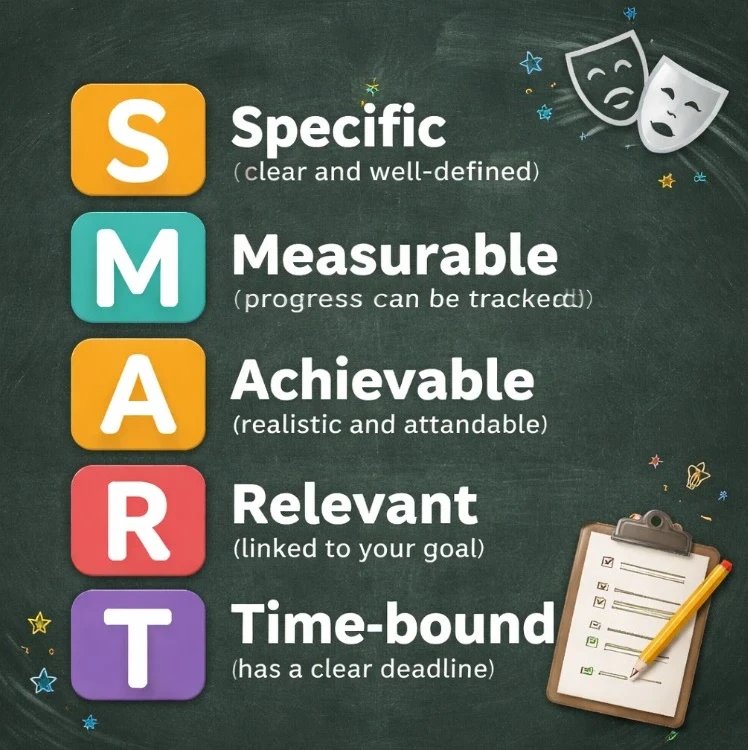
SMART is a simple framework used to turn vague aims into clear, achievable targets. A goal is considered SMART if it is:
- Specific – clear and well defined
- Measurable – progress can be tracked
- Achievable – realistic within the time and resources available
- Relevant – directly linked to learning outcomes or priorities
- Time-bound – has a clear deadline
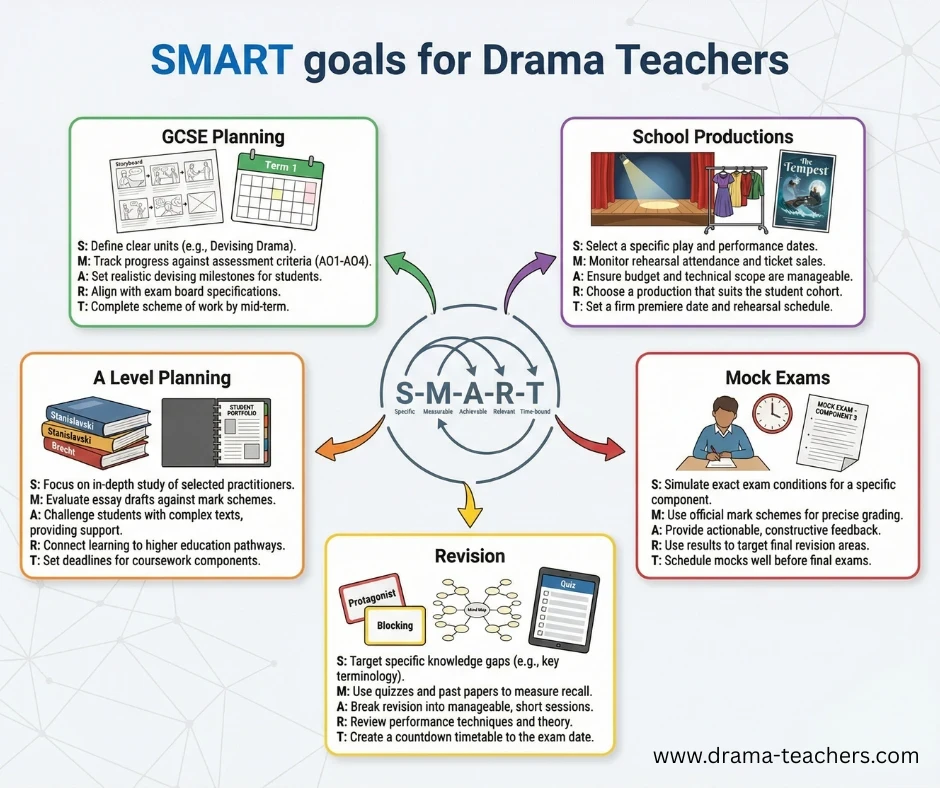
For drama teachers, SMART goals can support lesson planning, schemes of work, GCSE and A Level exam preparation, mock exams and practical assessments.
Why SMART goals work particularly well in drama teaching
Drama teaching involves balancing many different elements at once:
- Practical performance skills
- Written exam technique
- Devising and collaboration
- Technical theatre elements
- Rehearsals, assessments and productions
Without clear goals, it is easy to feel stretched or reactive.
Using SMART goals for drama teachers helps to:
- Prioritise what matters most
- Break large tasks into manageable steps
- Track progress realistically
- Reduce unnecessary stress for staff and students
SMART goals are not about doing more – they are about doing what matters, well.
Using SMART goals for GCSE Drama
Exam revision and written responses
Instead of a general aim like:
“Improve exam answers”
A SMART goal might be:
By the end of the spring term, all GCSE drama students will complete at least three timed exam questions using a PEEL structure, with teacher feedback and one redrafted response.
This goal is:
- Specific – timed exam questions with a set structure
- Measurable – three completed responses
- Achievable – built into lessons
- Relevant – directly supports GCSE drama exam preparation
- Time-bound – end of spring term
This makes GCSE drama revision purposeful rather than rushed.
Mock exams
Mock exams can be stressful for students and teachers alike.
A SMART goal could be:
Before the mock exam, students will complete two full practice questions under exam conditions and self-assess using the exam board mark scheme.
This supports:
- Familiarity with exam timing and expectations
- Reduced anxiety through practice
- More meaningful use of mock exam data
Practical performance skills
For practical GCSE drama work, goals are often most effective when they focus on specific skills rather than general confidence.
For example:
Over six lessons, students will demonstrate improvement in vocal projection, physical clarity and spatial awareness, evidenced through video recordings and peer feedback.
This makes progress visible and measurable in drama practical exams.
Using SMART goals for A Level Drama
At A Level, SMART goals help manage depth, independence and higher expectations.
Scripted performance work
A SMART goal might be:
By week four of rehearsals, all students will be off script and able to justify their performance choices using practitioner theory, verbally or in writing.
This supports:
- Performance quality
- Analytical understanding
- A Level drama exam preparation
Devising components
Devising can easily lose focus without clear milestones.
A SMART goal could be:
By the midpoint of the devising process, each group will have a clear stimulus, agreed intention and a structured outline of scenes, recorded in their logbooks.
This keeps A Level drama students focused on the assessment criteria rather than drifting creatively.
Written evaluation and reflection
Instead of:
“Improve evaluative writing”
Try:
By the final term, students will produce one full evaluative essay linking practical decisions to practitioner influence and audience impact, using exam board terminology.
SMART goals for school productions
School productions are a major part of drama teaching and often run alongside exam classes.
SMART goals help productions stay organised and realistic.
For example:
By the end of the first rehearsal week, casting will be finalised, scripts distributed and a rehearsal schedule shared with students and parents.
Or:
By the technical rehearsal, all students will understand their entrances, exits and cues, evidenced through a full run with notes.
These goals reduce last-minute chaos and protect staff workload.
 Use SMART goals to ensure all elements of a production come together properly.
Involving students in setting SMART goals
One effective strategy is involving students in the goal-setting process.
This might include:
- Individual performance targets
- Group goals for devising
- Turning mock exam feedback into clear action points
When students understand what success looks like, they are more likely to engage with the process.
Keeping SMART goals realistic and humane
SMART goals should support learning, not add pressure.
Before setting a goal, ask:
- Is this realistic within the time available?
- Does this support learning or just create extra work?
- Will this reduce stress or increase it?
One or two well-chosen SMART goals for drama teachers are far more effective than a long list that becomes unmanageable.
A simple starting point for the year ahead
To keep this manageable, choose one focus area:
- GCSE drama exam preparation
- A Level drama performance or devising
- Practical assessment skills
- Production organisation
Set one or two SMART goals and review them regularly.
Download your FREE SMART goals template here.
In conclusion
Drama teaching is complex, creative and demanding. SMART goals are not about limiting creativity – they provide a structure that allows creativity to flourish.
When goals are clear, realistic and relevant, they support students more effectively, reduce stress and make the year ahead feel far more manageable.
And that is a goal worth setting.
Let me know in the comments how you set your goals for the year and what you find works best?
Related posts
Drama warm-up activities and why they’re important
Drama games to build confidence
Teaching hub and revision resources